

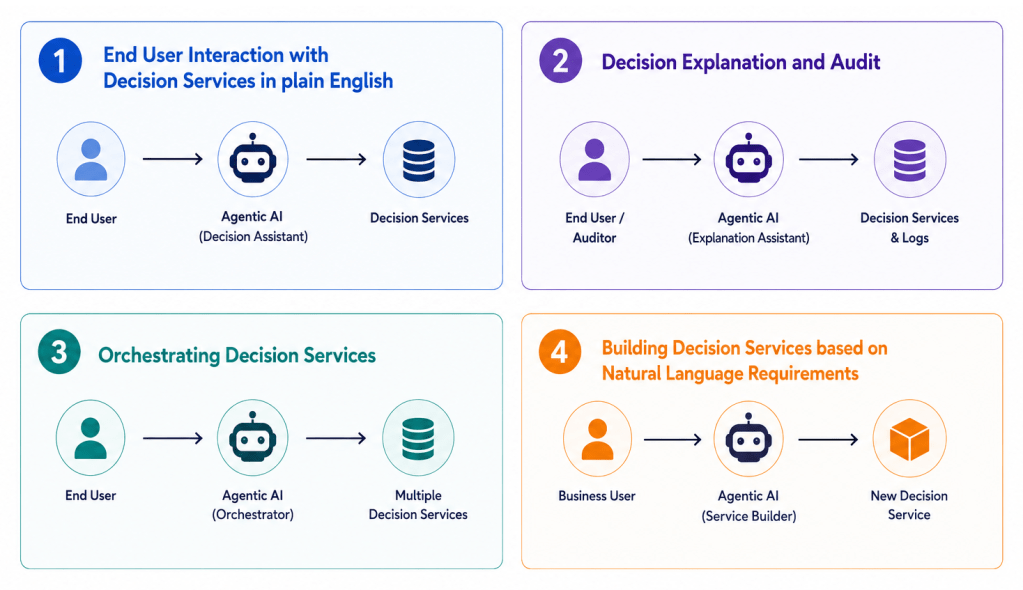
Agentic AI is transforming how decisions are built, consumed, orchestrated, and explained. Four major AI applications stand out in today’s Decision Intelligence context:
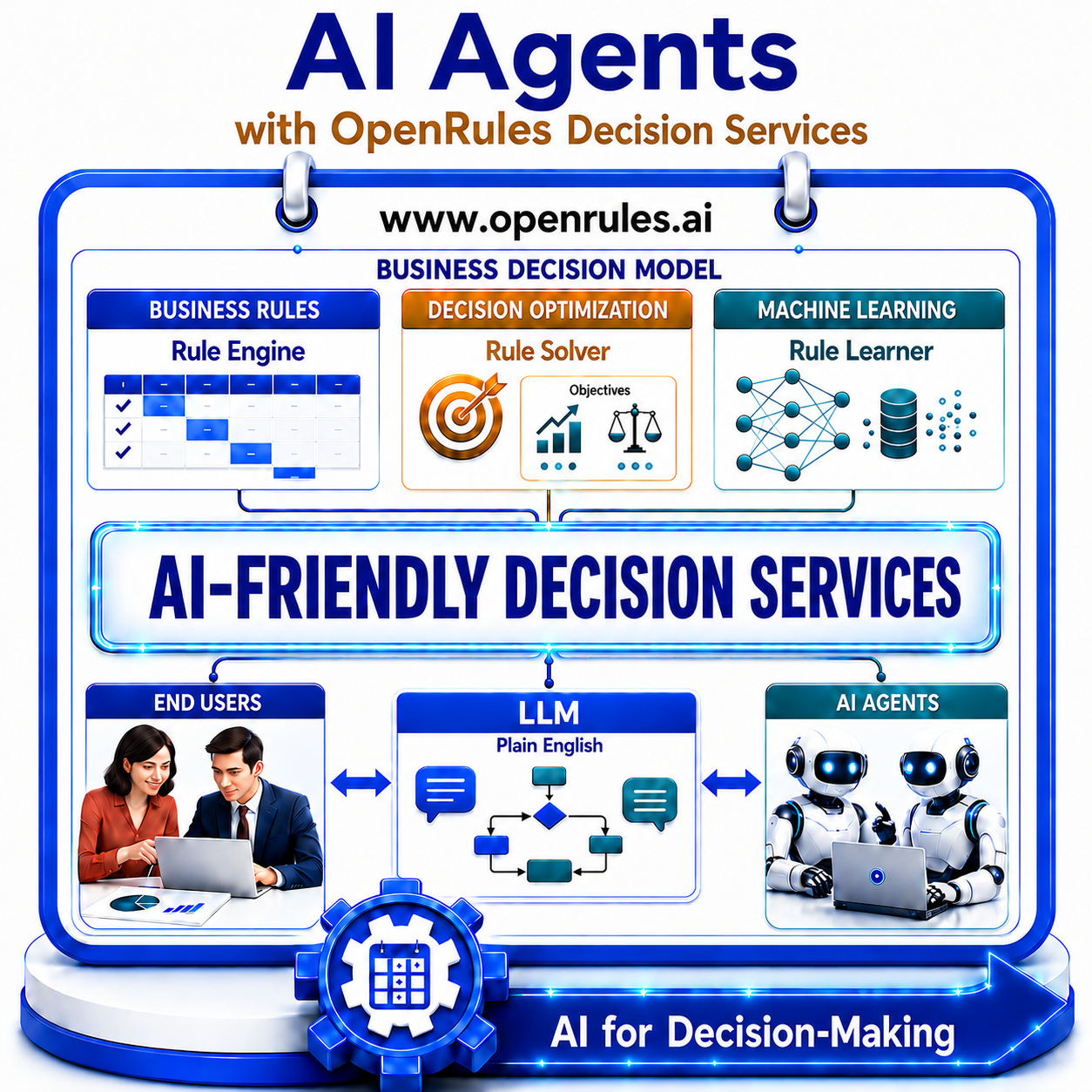
OpenRules helps its customers integrate their decision services with the latest advances in large language models (LLMs). When making critical business decisions with LLMs, however, it is essential to keep powerful — yet often unpredictable — generative AI on a controlled and reliable path. This is achieved by guiding LLMs to leverage proven decision intelligence tools such as business rules, machine learning, and optimization.
OpenRules addresses this need by enabling customers to automatically transform their decision models into independent, intelligent AI Agents, seamlessly accessible by leading LLMs such as ChatGPT, Claude, or Gemini. Let’s explore how OpenRules supports each of the four directions outlined above.
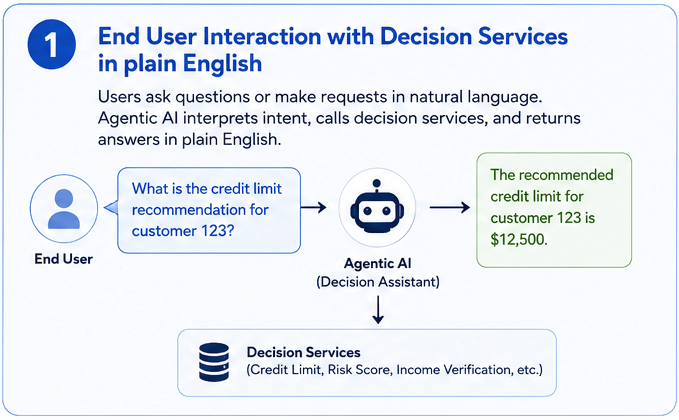
Today, this is the most practical use of LLMs, which essentially simplifies end-user interaction with existing rule-based and optimization-based decision services. OpenRules provides two ways to deploy its decision models as AI Agents:
- OpenRules decision services are AI-ready out of the box: no configuration required.
- OpenRules decision services as MCP Servers: the standard MCP configuration is required.
In both cases, an end user can interact with an LLM — such as ChatGPT Codex or Claude Code — in plain English, and the LLM will invoke OpenRules-based decision services as AI Agents. We also provide a built-in OpenRules AI Assistant, which is particularly useful for testing decision models in plain English and simulating various end-user interaction scenarios.
Throughout a dialogue with an end user, the LLM does the following:
- Transforms all decision service outputs into natural language responses, capturing both the result and the underlying reasoning
- Determines which services to use and when, guided by the available prompts
- Automatically generates and dispatches JSON-formatted requests to the appropriate AI Agent for execution
- When input data is incomplete, the LLM prompts the user accordingly and proceeds to execute all related decisions and sub-decisions.
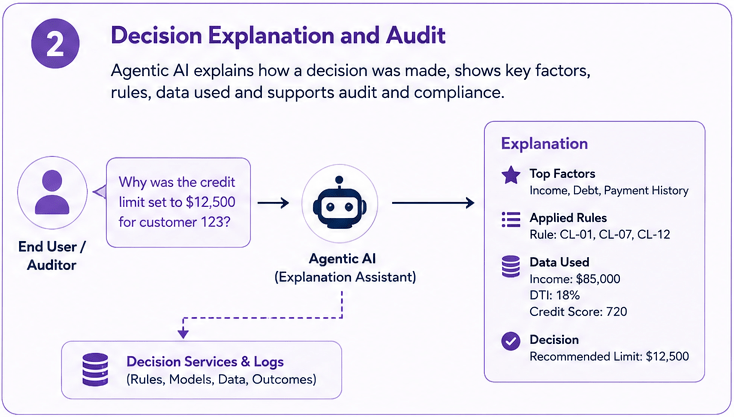
Throughout a dialogue with an end user, the LLM provides transparent explanations of which services and rules were invoked and why, rendering technical logic in plain English. See examples in the dialogs on the right.
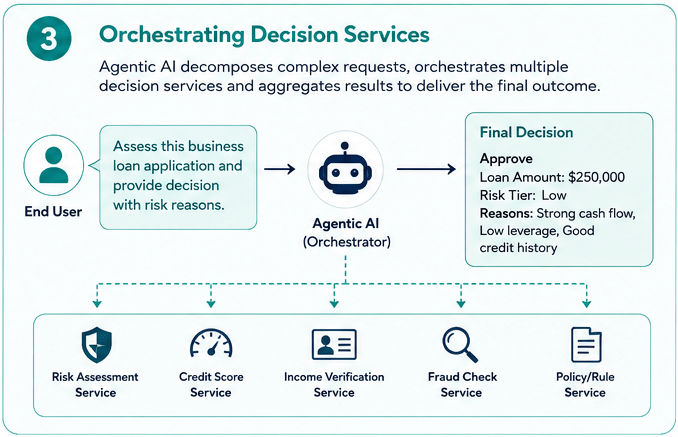
LLMs are fundamentally transforming the orchestration of decision services. They enable end users to interact with multiple existing decision services in a natural, flexible way — without any custom-built interfaces or rigid workflows. See 3 interconnected decision services orchestrated by an LLM here.
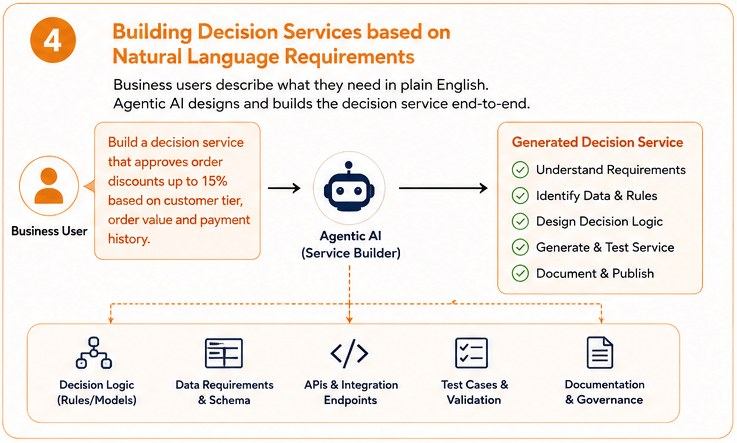
LLMs aren’t decision-makers — at least not yet. We have already seen relatively successful generation of OpenRules decision models from plain English descriptions of business logic. We are aware that leading LLMs have already acquired substantial knowledge of core OpenRules concepts and their representations, and are capable of producing good-looking decision models in “almost” correct OpenRules formats. See Example-1 and Example-2.
Despite serious progress, LLMs still produce invalid decision logic frequently enough that it can be easier to build a new decision model from scratch using the standard OpenRules Decision Modeling IDE than to find and fix errors in a generated one. That said, automatically generated glossaries and decision tables can still be reused within OpenRules Explorer. For now, OpenRules customers can interact directly with ChatGPT or Claude to generate decision models in OpenRules format. Once LLM results become more stable and reliable, we plan to add a dedicated AI Assistant to OpenRules Explorer.

